
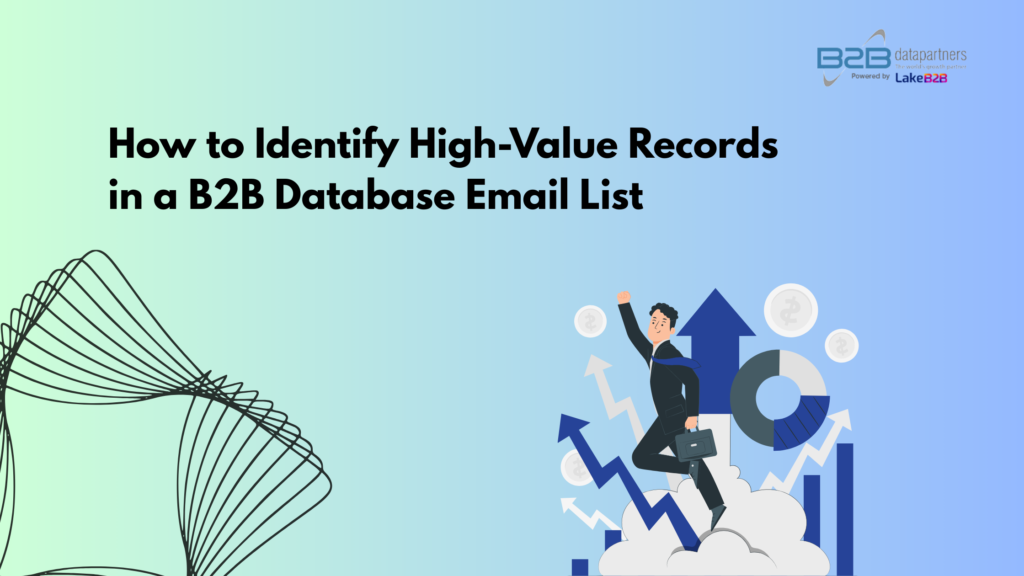
A strong B2B Database Email List is one of the most valuable assets for any B2B company. It fuels lead generation, email marketing, sales outreach, account-based marketing, and long-term customer nurturing. However, the truth is straightforward: not every contact in your B2B Database holds the same value.
- Some records are inaccurate.
- Some are outdated.
- Some don’t match your ideal customer profile.
- And some aren’t ready and may never be prepared to make the conversion.
To improve your marketing ROI, you need to know how to find the high-value records in your B2B database, B2B data lists, or B2B contact lists. High-value contacts are those most likely to become qualified leads, pipeline opportunities, and long-term customers.
This guide explains how to find these contacts, what signals to look for, how to score your contacts, and best practices for keeping a clean, revenue-ready database.
What is a high-value record in a B2B database email list?
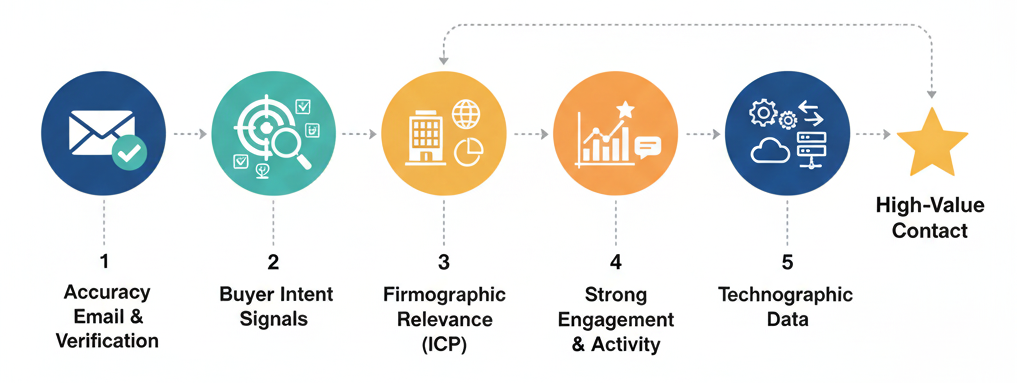
A high-value record is a contact in your B2B Database Email List that possesses a strong combination of the following :
- Accuracy – information is accurate and current
- Relevance fits your ICP – industry, role, company size, location
- Intent – shows interest or buying readiness
- Engagement – interacts with your emails, website, or sales team
- Conversion potential – realistically could become a customer
High-value records help you:
- Increase email deliverability
- Improve email open and click-through rates
- Strengthen campaign targeting
- Drive a more predictable sales pipeline
- Lower customer acquisition cost (CAC)
- Boost overall marketing ROI
That is why identifying and prioritizing these contacts is crucial.
Key Indicators of High-Value Contacts in Your B2B Database
Here are the main signals to watch for when figuring out which records need your attention and marketing resources.
1. Complete & Verified Contact Information
High-quality B2B outreach requires complete contact data. A high-value record should include:
- Full Name
- Verified Business Email
- Job Title
- Department – Marketing, Finance, IT, Operations, etc.
- Company Name and Website
- Industry
- Company Size and Revenue
- Country or Region
- Phone Number
- LinkedIn or other social profile
Why this matters:
Incomplete or incorrect contacts lead to email bounces, misdirected outreach efforts, and wasted campaign results. Verification tools like ZeroBounce, NeverBounce, or Apollo help validate and maintain accuracy.
Red flag signs:
❌ Generic emails like info@ or support@
❌ Outdated job titles
❌ Inconsistent data (multiple spellings of the same company)
These records usually have lower list quality and are not high value.
2. Clear Buyer Intent Signals
Understanding buyer intent is one of the most effective ways to identify valuable contacts. High-value records often show clear signals such as:
- Visiting product or pricing pages
- Downloading eBooks, whitepapers, or case studies
- Signing up for webinars or demos
- Comparing your product with competitors
- Searching keywords related to your industry
- Engaging with your paid ads
- Responding to nurturing emails
Why intent matters:
It tells you who is actually in the buying journey instead of who just happens to be in your database.
Modern tools like Bombora, ZoomInfo Intent, and behavioral tracking within CRMs can help identify contacts with increasing interest.
3. Firmographic Relevance to Your ICP
High-value records almost always match your ideal customer profile (ICP). Key ICP fields include:
- Company size – employees & revenue
- Industry
- Geography
- Business model: SaaS, manufacturing, services, etc.
- Budget capability
- Use cases relevant to your product
If a contact’s company fits the criteria your product serves best, they’re automatically more valuable.
Example:
If your software is built for HR teams in mid-size tech companies, a VP of HR from a 300-employee SaaS company is a high-value record.
But an intern from a 2-person startup is not.
4. Strong Engagement and Interaction History
Consistent engagement is a powerful indicator of high-value potential. Look for:
- Email opens and link clicks
- Repeated website visits
- High time spent on key content
- Positive replies to outreach
- Recorded interest from sales reps
- Participation in surveys or events
These interactions prove the contact has interest, awareness, and trust in your brand.
Signs of low-value contacts:
❌ Never opening emails
❌ Non-existent website activity
❌ Unresponsive to sales follow-ups
5. Useful Technographic and Behavioral Data
Technographic data reveals the technology stack a company uses. This is especially helpful for SaaS, IT, and technology vendors.
A high-value contact may use:
- Tools you integrate with
- Software your product can replace
- Platforms that complement your product
- Competing software (showing switching potential)
Behavioral triggers may include:
- Free trial sign-ups
- Pricing page comparisons
- Chatbot inquiries
- Repeated visits to specific product pages
These signals indicate higher readiness and likelihood to convert.
Methods to Assess and Score High-Value Records
Now that you know what to look for, here’s how to evaluate and prioritize the records in your B2B Database Email List.
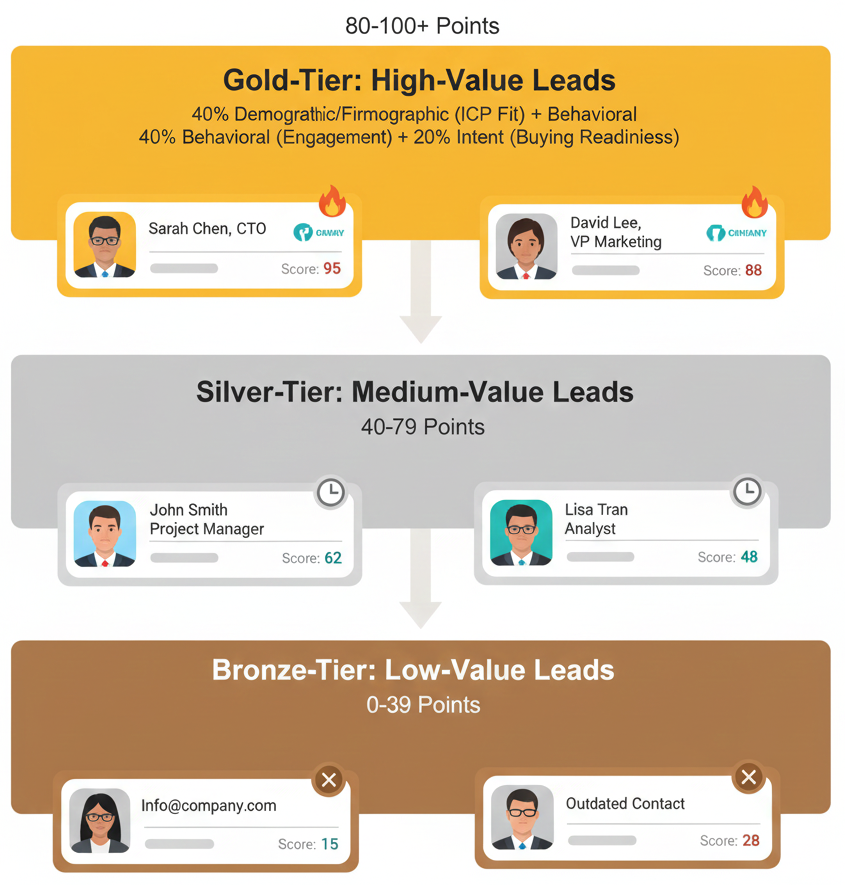
1. Create a Lead Scoring Model
Lead scoring assigns points to attributes and behaviors. This helps identify:
- High-value leads
- Medium-value leads
- Low-value leads
Example scoring categories:
Demographic/Firmographic (40%)
- Job title (seniority)
- Industry
- Company size
- Location
Behavioral (40%)
- Email engagement
- Website activity
- Content downloads
- Demo/trial sign-ups
Intent Signals (20%)
- Third-party buyer intent
- Competitive research
- High-intent keyword activity
High-scoring contacts = high-value records worth prioritizing.
2. Data Enrichment for Better Insights
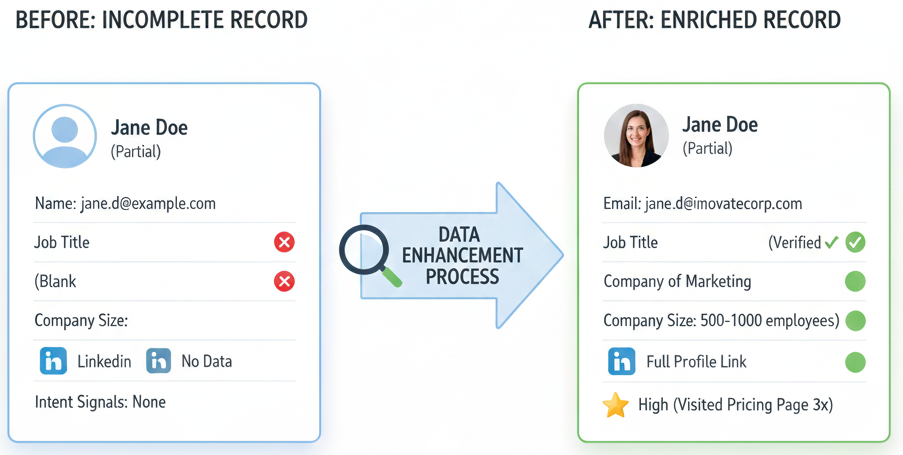
Data enrichment fills the gaps in your b2b data lists. It improves accuracy by adding:
- Updated job titles
- Fresh company data
- Social media profiles
- Revenue and size insights
- Technographic details
- Intent signals
Enrichment gives incomplete contacts new value and improves segmentation, personalization, and lead scoring accuracy.
3. Regular Data Validation & Cleansing
Maintaining a clean B2B Database is critical. Clean your records by:
- Removing duplicates
- Updating job roles and companies
- Fixing incorrect formats
- Deleting invalid emails
- Flagging inactive contacts
- Eliminating spam traps
Poor-quality data hurts deliverability and reduces the performance of your entire database.
Recommended schedule:
- Light cleaning: monthly
- Full audit: quarterly
- Deep enrichment: every 6 months
Best Practices to Maximize High-Value Outcomes
To maximize conversions from your high-value records:
1. Segment your database properly
Use segments by:
- Industry
- Role
- Intent stage
- Buyer journey stage
- Region
- Company size
Segmentation increases relevance and thereby increases conversions.
2. Personalization of Messages
Use dynamic fields to personalize:
- Subject lines
- Email content
- Calls-to-action
- Product recommendations
- Case studies
Prospects convert when they receive content that speaks directly to their roles, goals, and challenges.
3. Employing Automated Workflows
High-value leads should enter automated sequences such as:
- Lead nurturing
- Re-engagement flows
- Demo follow-up sequences
- Buying-stage workflows
Automation guarantees timely and consistent communication.
4. Align Sales & Marketing
High-value contacts should be visible to both teams. Sales terms need insights from marketing and vice versa, in the form of feedback from sales.
Regular alignment meetings improve lead scoring, handoffs, and conversion predictions.
Common Mistakes to Avoid
Even with a strong B2B database, many companies commit common errors such as:
❌ Buying cheap, outdated b2b contact lists
❌ Ignoring email validation
❌ Overlooking engagement metrics
❌ Treating every contact equally
❌ Not updating ICP criteria
❌ Relying only on old firmographic data
❌ Targeting irrelevant industries or job roles
These errors decrease deliverability, inflate marketing costs, and reduce pipeline quality.
How High-Value Records Improve ROI
By focusing on high-value contacts, your company stands to benefit from:
- Better email engagement
- Stronger sales conversions
- Lower cost per lead
- Faster sales cycles
- Higher-quality pipeline
- More effective personalization
- Better forecasting accuracy
- Stronger long-term customer value
High-value records create predictable growth and significantly reduce wasted marketing spend.
Summary
The key to running effective marketing and sales operations involves the identification of high-value records in your B2B Database Email List. By paying attention to verified contact data, intent signals, firmographic relevance, and consistent engagement, you’ll have a database that drives real business results. Whether through B2B data lists, curated B2B contact lists, or an enhanced B2B Database, the point is continuous evaluation, scoring, and hygiene of the data.
A clean, enriched, and strategically optimized database doesn’t just improve your marketing; it becomes one of your most powerful revenue engines.
Start Scoring Your Leads Today With B2B DataPartners
FAQ
Database maintenance should follow a consistent schedule, with light cleaning monthly, full audits quarterly, and deep enrichment every six months. Regular cleaning removes duplicates, updates job roles and companies, fixes incorrect formats, and deletes invalid emails.
Lead scoring ranks prospects using numerical values based on characteristics and actions, helping determine sales readiness. A typical scoring model assigns points across three categories
demographic/firmographic data (40%), behavioral engagement (40%), and intent signals (20%).
In-house data is collected by internal teams and can be highly targeted, but is time-consuming and expensive to maintain, while opt-in data is voluntarily provided and more likely to convert, but harder to collect.
Conduct a test campaign using sample records by sending a small batch of emails to see how many bounce back or result in invalid addresses. Request sample data to check information completeness and format. Look for providers offering accuracy rates over 95% and ask about their data sourcing methods and compliance with regulations like GDPR and CAN-SPAM.
High-value records demonstrate multiple positive signals: complete and verified contact information, clear buyer intent through content engagement, firmographic alignment with your ideal customer profile, consistent interaction history, and relevant technographic data.